By now, I think most people agree that aim trainers do help you in real games. There are so many testimonies of improvement because of the focused practice they promote and there are countless pros across basically every big esport at the moment who use them actively. But there is another question I’ve seen fairly often over the years which doesn’t have that same unified consensus:
When do aimtrainers stop being useful? At what skill level is improving in aim trainers all about getting better at aim trainers, instead of getting better at aiming in fps games?
And it’s kind of intuitive right, there are a lot of mechanics within fps games that you can’t train within an aim trainer so it makes sense that there would be a point where your raw aim is “good enough” for whatever game your training for, and that your time is better spent playing the game than in an aimtrainer. This idea is further supported by aimtrainers pushing aim so much further than it usually is within games with faster and smaller targets.
But is that actually the case? Is there actually a point where your raw mechanics can be so good that any improvement on top of that to only be visible in aim trainers, and if there is, where is that point?
The commonly accepted limit: VT Master
The first time I saw this question was when I was initially getting into aimtraining. This was maybe 4 years ago now; the community was a lot smaller and because of that there wasn’t really anywhere to go for information about aimtraining other than a few discord servers. I remember the reply was something along the lines of “it’s very useful when you’re new but trails off as you get better, I honestly can’t tell a Master ranked player apart from the best aimtrainer players in actual games.”
At the time I was 20 hours in and had just hit Platinum on the Voltaic benchmarks, and I was improving my scores everyday, with my in game performance following suit. I was honestly a little shocked just how much it helped me, I had already ironed out so many issues with my mechanics and I didn’t see how that improvement could just… stop. That being said though, I was only 2 ranks away from master, which was scarily close to their proposed limit to how far it’s worth climbing on these benchmarks.
This was in the back of my mind as I kept playing, but the benefits I felt in game didn’t stop when I did get Master. After 80 hours, it still felt like I was getting better each day and watching old clips made it very easy to see my improvement. This was also around the time I began to really enjoy aim training—it was satisfying to see my scores go up overall but I especially liked speed focused scenarios.
By 400 hours I was still Master overall, but had pushed my speed target switching to the very top rank. I began to put more time into aimtraining than I did actual games, and when I did play fps’s I didn’t do much better than I did 300 hours of training earlier. My flicks felt faster from all the speed practice but I lost a lot more gunfights than I did even before aimtraining at all, which honestly really affected my confidence.
After all this time practicing, I still couldn’t win my duels. I remember thinking back to that comment, about how master was the cutoff point, and realising that it did mostly align with my experience, my progress slowed down around master II. The reason why I started all of this was to get better at fps games, and if aimtraining wasn’t going to help me anymore, why bother?
Because of that I mostly stopped playing aimtrainers and went back to putting all of my time into FPS games, and I started seeing improvement in them again. I hit new peaks in CS:GO, my flicks felt sharp in Battlefield, and my confidence started slowly coming back.
I felt like that original comment was right, and that aimtraining had no value in games after around Masters.
But if that was the case, what would be the reason? My guess is that no game that I played stressed raw mechanics enough for it to make a difference. CS:GO focused more on crosshair placement and microadjustments than wide flicks, the same was true for Valorant, and my flicks were already good enough for Battlefield and CoD. Even in a game like Apex with a longer ttk, my tracking improved from just playing the game more than it did from aimtraining. I had already gotten my underlying mechanics to a high enough level, with every skill being at least Masters, and any extra time spent aimtraining would be wasted just like the last 300 hours were. I did play a bit more after this, but it was exclusively for fun, not with the goal of improving in games.
Challenging my conclusion
I’m sure some of you can see the flaw in my logic already, but it took until mid 2022, when I finally came back to aimtraining, for me to spot it. I started playing again to compete with a friend and one of his friends, he challenged me to beat their scores in a few different tracking scenarios. This was one was one of my weaker skills, mainly since I barely played it when aimtraining prior. It was a bit of a grind with some back and fourth between us but I eventually did match and even surpass them both, bringing my tracking up to the same rank as my old target switching scores. And, to my surprise, when trying out Apex again after all this I felt a massive improvement in my ability to read and track enemies movements, I was so much more consistent.
Throughout that entire competition I was just doing it, well, to compete! I had fun trying to beat my friends scores and pushing myself further, but I honestly didn’t think it would help since my tracking was already pretty good in aimtrainers. Ever since I first heard the idea of a limit to aimtraining’s helpfulness I’d seen that idea mirrored by so many people, placing that limit around the Jade or Master ranks. That was meant to be the point where any progress further was just getting better at aimtrainers, learning the scenario and whatnot, but if that was the case, then why did I improve so much going from Grandmaster to Astra?
Watching back my old clips, my flicks actually did improve a lot after playing aimtrainers, but it was other parts of my aim that made it feel like they hadn’t.
So now, I’ve trained both reactive tracking and speed switching up to an Astra level and felt benefits in games from both, so where does that put our limit of aimtraining’s usefulness? The intuitive answer is astra, but does my experience really prove it? What if it was just placebo, what if it was just those 2 categories that translate over well?
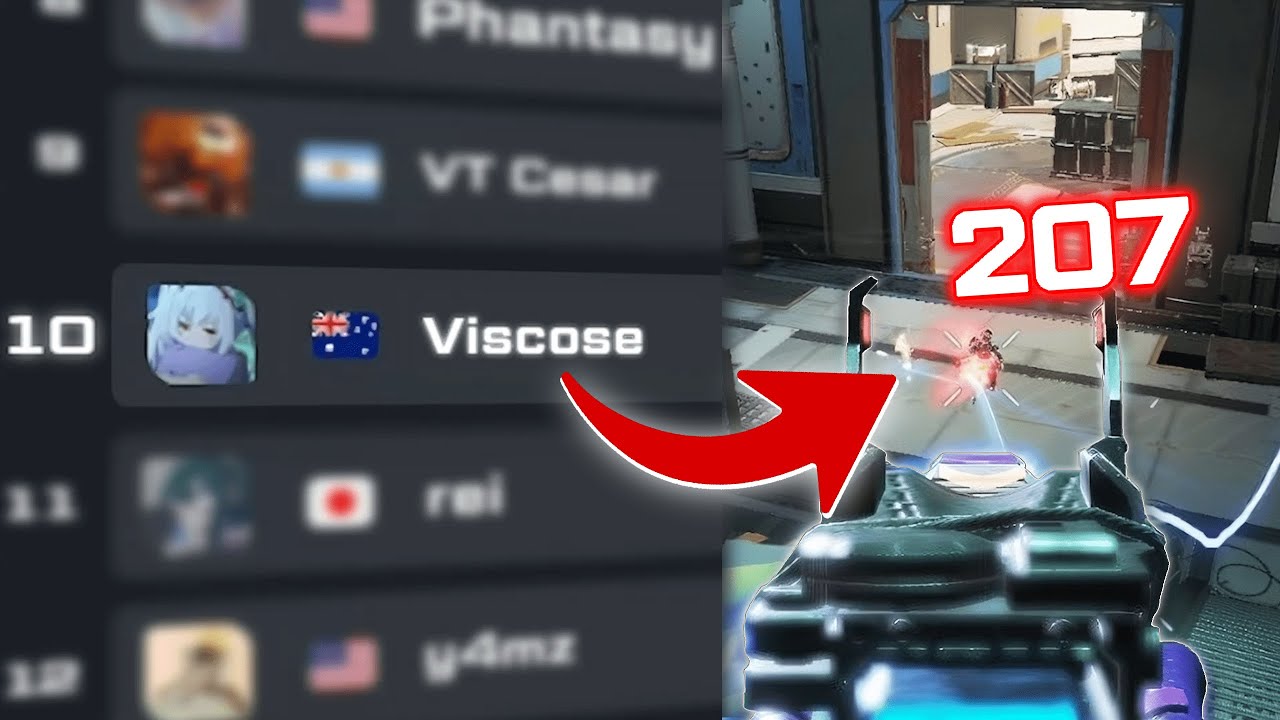
I don’t feel like I’d do the topic justice without putting these questions to the test myself. One of my longest goals in aimtraining has been being in the top 10 worldwide on the season 3 voltaic benchmarks. This is my scoresheet currently, placing me at #54 on the leaderboard. To get into the top 10, I would have to push every scenario to astra as well as pushing around half to celestial. I… don’t even know if it’s possible for me, it’s a very far out there goal but I think it’s needed if I want to properly answer this question.
So, I did it.
After reaching top 10 worldwide as well as pushing all of my scores past my old peaks, I can say that honestly, it helped me way more than I thought it would.
Even knowing what I did about how pushing my scores to Astra helped in the past, it was still a little unreal to see just how much better I ended up getting after this, especially with the Finals releasing in the middle of it which really rewards mechanical skill. There were a few scenarios that didn’t help much in games, but these were the exceptions. This is even more crazy to me considering that I was doing something I don’t normally do and that you’re not meant to do for in game improvement, even though I did play other scenarios to practice most of my time was spent grinding the benchmarks.
Why did I get worse?
This does raise the question though, if getting to the top 10 helped me so much, why was I losing more duels before I stopped aimtraining way back? I think what it came down to was:
While I had pushed the ceiling of my mechanics higher through all the speed practice, because I was going for those faster flicks I lost some of the consistency I had before when flicking slower.
When I stopped aimtraining I stopped trying to flick as fast and because of that, got some of my consistency back. After playing aimtrainers again recently though, I have the consistency to go for those quick flicks and if I do miss, I can fall back on my strong microadjustments to secure the kill which I just didn’t have developed before.
Why it will ALWAYS be useful.
I think consistency really is at the center of all this, it’s the main thing aimtrainers help with for me and also rebuts another one of the explanations I had for why aimtrainers didn’t work in the past. While games don’t push aim as far as aimtrainers do in individual situations, that doesn’t matter since what you’re searching for is consistency, which can almost always be improved.
Even if you can aim at a target way smaller or more evasive than anything seen in any fps game, could you do it every time? Because in games, you HAVE to. You can’t reset the run or load up a different scenario, when you are placed in a situation that calls for good mechanics you have to aim well in it, every time, or lose. This is why I think aimtraining will always have its uses at any skill level, while it’s exceptionally useful for new players even very experienced players will benefit from building that consistency, which is easier in aimtrainers due to it’s long scenario times. On top of that, they help you stay consistent by removing the downtime between aiming present in games, especially compared to a battle royale like Apex.
Scenario Selection
Another big mistake I made; was in my scenario selection. When I was aimtraining a lot, I was putting almost all of my time into target switching and barely any into my other skills. This was honestly really visible watching my gameplay: my flicks were sharp but my microadjustments were very inaccurate. In games like Counter-Strike though, those microadjustments are what really matters; most of the time you’ll be correcting to someone near the angle you are preaiming so the total amount of mouse movement you end up making is very minimal.
The same thing applies for Apex; I should have been focusing on my smoothness instead of trying to work on my adjustment speed. That game has relatively slower acceleration, so being able to snap back onto a target instantly when tracking isn’t as useful as maximising your damage on strafes.
I think this is something a lot of people get wrong when trying aimtrainers. While lower ranked players can play all aiming categories equally and see improvement regardless of the game, if you’re already above, say, Diamond on the Voltaic benchmarks, the general mouse control gains will stop being as visible from day to day and you’ll benefit from specializing a little.
Watch clips back and see what kinds of movements your making when aiming, and choose scenarios in aimtrainers that contain similar movements to isolate them, it doesn’t have to be 1:1, as long as its hitting the same general skillset it’ll be so much more effective than exclusively playing popular scenarios or even the benchmarks.
That doesn’t mean the other categories are useless, but it’s important to bring your fundamentals up to a strong level to provide a solid base to build upon when trying to lean into niches. It loops back around to consistency in a way: just as you need to in games, building fundamentals is about making sure you can do simple movements perfectly, every time.
Aim really is a lot more in depth than most people think, even at a very high level there is still so much to isolate and improve upon and the results of that training do shine through into fps games. It’s a skill with basically no ceiling, and while it isn’t the only deciding factor in most games there are a lot of duels that basically just come down to who can click on the target better.
Closing thoughts
That doesn’t mean you can just neglect playing fps games if you want to have good aim within them though. The way I see it, aimtraining builds your raw aim, or mouse control, which is an underlying skill that supports game specific skills. The better your raw aim is the easier it is to develop these skills, but they still have to be developed independently. This is another thing that I did wrong before; I played more aimtrainers than FPS’ and thought that since my raw aim was good it would just carry over without any effort, but without learning the game itself I couldn’t fully leverage my aim to excel within it. Looking at the Finals as an example, when trying to pick it up recently I focused on learning the recoil patterns, finding out about techniques like recoil smoothing, getting familiar with how fast different characters accelerate and adapting to aiming at bounce pads, grapples or dashes. I could isolate all of that from my raw aim since I didn’t have to think about my underlying mechanics at all, which along with spending far more time playing the game then I did aimtraining led to me picking it up rather quickly.
At the end of the day, aimtraining should always be supplementary to playing the game. When I was grinding for Top 10 on the Benchmarks, my time spent aimtraining was much higher, but now that my focus is on fps games specifically I spend about 15 minutes warming up before I play and 30-40 minutes focusing on issues I noticed during the play session afterwards, and only benchmarking myself for about an hour once a week. This is what I think works best for me and gives me the most value for my time, but that will probably be different for you. Different games place different levels of emphasis on game specific mechanics vs raw aim, and it’s best to decide how to balance your time based on that.
Generally though, I wouldn’t recommend spending more than 20% of your playtime on an aimtrainer.
To end this off I just want to say that, even if this hadn’t of helped in game I wouldn’t regret the time I spent. Half a year ago I never would have even dreamed of being at the level I’m at today in aimtraining, setting myself a goal like this and slowly working towards it was so rewarding, and the payoff of actually achieving it was more than worth the hours I put in. I learned a bit about what methods work best for me when striving for something like this as well, from how to discipline myself into doing somewhat tedious tasks to breaking the task into smaller chunks and hyperfocusing on each, which honestly will help me in other areas of my life too. It’s already helped me when making this video. This project has been very fulfilling for me and its reminded me of the power that setting clear goals and chipping away at them can have, both in and outside of fps games.