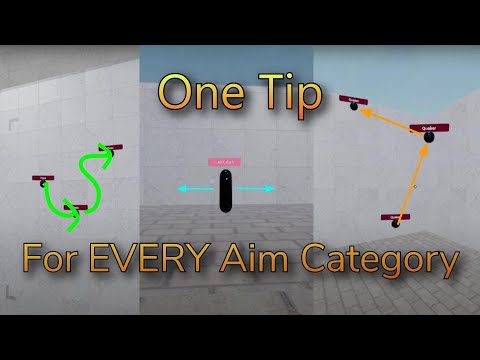
Hello everyone, it’s VT Matty, and today we’re doing a quick video where I give you one strategic or technique-oriented piece of advice for every subcategory of aiming in aim training. Let’s jump right in with static clicking:
Static Clicking
Everyone knows that you’re supposed to farm clusters, but no one really talks about what happens when you leave a cluster. There’s often a break in pacing that causes you to miss your next few shots or delay the rest of your path. To mitigate this, a common strategy that VT Cartoon employed was inward pathing–Start by going for targets around the edges of the map and then path inwards depending on where you see clustering. This helps you to both stay safe in terms of your crosshair positioning on the map, and it gives you a good plan on what to do when you transition out of clusters.
XY Dynamic Clicking
That is Pasu or Angleshot types, it will help you a TON if you suspend your micro corrections after flicks if you are confident on your target read. It often is better to treat these movements as linear and take safer leading shots instead of going for a distanced micro. Even if you land this micro, it can throw you off course, and if you miss the micro, it’s even harder to recover. Additionally, in the moment that you are leading your shot, you have some time to look for a fall-back target.
Bounce/Arc Dynamic Clicking
You want to envision a horizontal line in the center of the map. This is the central line that targets will cross at a speed that you can very easily read or predict. After passing this line, rising targets will decelerate, and falling targets will accelerate. You want to position your crosshair along this line, as it is the location where it is the easiest to farm targets.
Linear Clicking
You will find that many scenarios have central spawning targets. The easiest way to get a good score on these scenarios is to play heavily for accuracy and spawn farm. Pick 2 targets that you want to farm and just bounce between them the whole time. This is very easy to get down with some practice, and it works so well because you only need one initial read as soon as the target spawns for you to be confident of its strafe, since this isn’t a more evasive category.
Elusive Clicking
Or as most of us might call it, Aimbeast dynamic or MBM dynamic, you can lead shots, but you will often need to do so from the opposite strafe direction. Because of how hyperactively these targets like to move, you can often recover from missed shots by microing ahead of the opposite side of the target’s strafe. About 8 times out of 10, the target will have already begun this exact strafe by the time your micro lands.
Precise Tracking
Give the “Lorys” trick a try. Lower your FOV to around 90 OW and increase your sensitivity to something like 25-35cm. Then play for around 15-20 minutes. I guarantee you will PB when you return to your normal settings. This trick works because it makes your errors way more visible, so you are more conscious of the shakiness in your aim.
Raw Smoothness
You generally do not want to reset your mouse position at all, but if you need to, it is far better to reset early and with a small adjustment than reset later and abruptly. Sometimes, when the target is about to change direction and you don’t need to reset, just do it anyway to be safe.
Control Tracking
You need support from tension in your fingertips to control vertical adjustments, not in your forearm. Remember that for the smaller motions, you can bend your fingertips to move the mouse vertically. This is the essence of control. Don’t use the muscle group designated for a wide range of mobility for a narrow motion.
Reactive Tracking
In Reactive Tracking, you sometimes want to read narrow strafes as if they are long strafes. For example, on Air Voltaic bot 4, there is often a bias that the bot is moving towards, even if smaller strafes point the opposite direction. You need to trust this bias while continuing to maintain stability on the small strafes. Try to view this bias as a force that the bot is “attracted” to but is also being constantly pushed away from. The force it is chasing is that overall long strafe, and the repulsive forces showing up in the opposite direction are the narrow strafes.
Pure Reactivity
In Pure Reactivity, or Aimbeast Reactive, you DO NOT want to edge track. Having smooth micros will not help you when the targets have instant acceleration. They will not give you leeway. Instead, you want to get back on target here by flicking. This means you will be spiking the tension in your wrist each time, and the smoothness of that flick’s landing will depend on how seamlessly you let go of that tension.
Speed Switching
If you want to develop really seamless transitions between targets, don’t listen for the kill sound or watch the target’s health bar. Set your hitsound rate to something a little bit slower and memorize how many hitsounds it takes for each target to die and move on using that as a marker.
Evasive Switching
When you land your flicks, you want to do so by transferring the tension from your wrist or forearm into your fingertips to follow through with the tracking motion. Don’t rely too much on the deceleration of your flick to handle the track for you. The TTK will often be too high.
Stability Switching
It can sometimes make sense to avoid flicking entirely. This is because these scenarios are so focused on maintaining really smooth tracking motion, almost to the level of raw smoothness. Mostly, you want to be focusing on target prioritization. Pick targets that are in the most ideal position, whether it be ones at the center of the map or ones at the slowest point in their motion.
Closing Notes
And that is all of the categories. I hope you guys learned something from this video, hopefully something that will get to much higher scores in the VT benchmarks and improvement across a wide variety of aiming scenarios. Let me know in the comments if you guys would like to see me do this again. Follow my Twitch to see streams where I implement these strategies and conduct VOD reviews around them. As always, happy dot clicking!