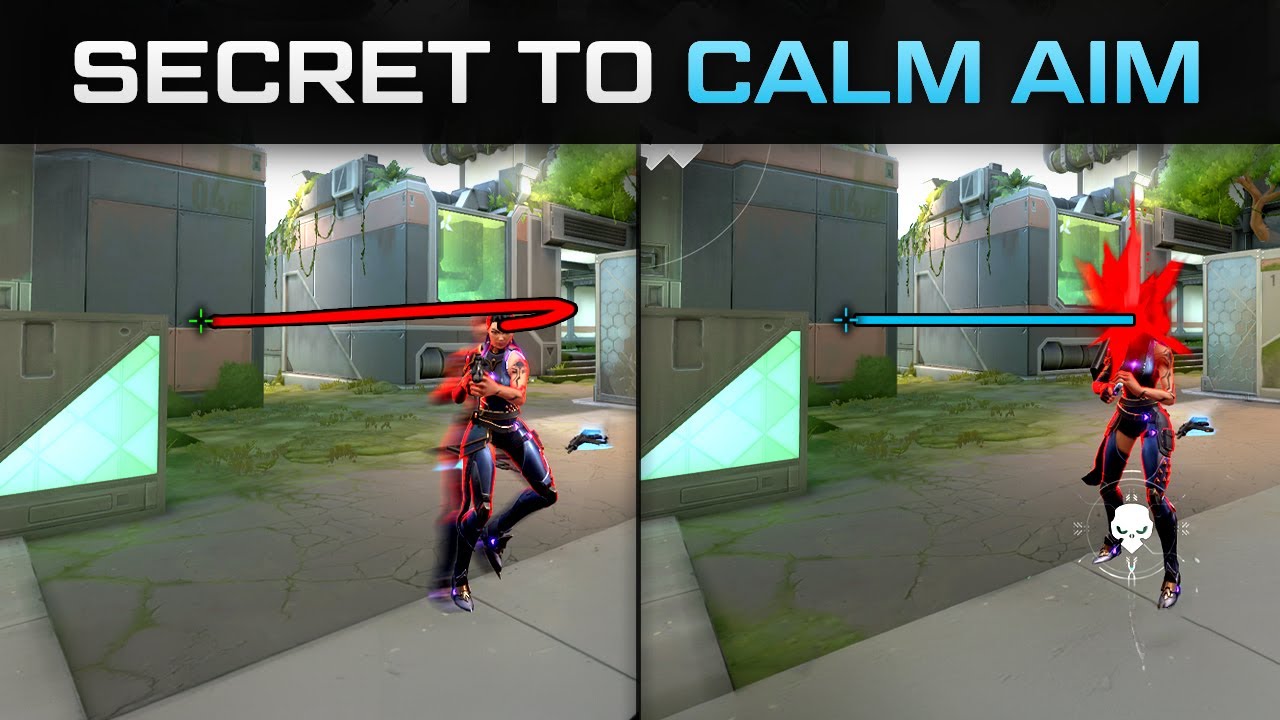
this was originally a Voltaic video released in 2024. On Dec 26, 2025 , I (pingu) decided to add a bit more depth and disambiguation to that old script since I’m not as concerned with making an entertaining video here! I’m really happy with the intro in the video (aside from the music that the channel owner replaced x_x) and it doesn’t translate to text well; you might wanna watch that and come back after around 1:28, picking up at the “What is Smoothness?” paragraph.
Introduction
One of the most deceptively challenging things to hit in FPS games is Fast Strafes, where your enemy is mashing A and D like they’re playing a rhythm game and their character model erratically changes directions. This happens in pretty much every game that allows for quick directional changes, but there’s actually a way to make this kind of aiming a lot easier.
The Many Elements in the Tracking problem
The secret is that mouse control is not the sole variable:
when trying to track someone, actually getting your crosshair on target is only half the battle, you have to determine where they are and where they’re going first. You have to read their movement.
Trying to track without developing the skill of movement reading is like me trying to hit a baseball without wearing my glasses. I might be able to get a vague idea of where the ball is but because I can’t make out exactly where it’s going I’ll struggle to hit it.
But aside from the enemy’s dodge, there’s one more element that affects how hard it is to read how the opponent is moving. You can see if it you watch the #1 run on any fast strafes tracking scenario compared to somebody less experienced. It doesn’t even look like the same scenario. The bot actually looks like it’s moving slower and changing directions less often on the WR run. And it’s not just good RNG, it’s something the player is doing.
So, how can we put on our metaphorical glasses and get this clearer picture of what the enemy is doing in real time?
What is smoothness?
That player has mastered the skill of smoothness, the core concept that underpins not just movement reading but almost every part of aim. I think the best way to define it is as such:
Smooth aim has no excess movement and a continuity of motion that comes from having a fine control over the acceleration and deceleration of the mouse.
People often view snappiness and smoothness as diametrically opposed concepts but a fast flick can still be smooth through the way we’re defining it here. By prioritizing smooth and continuous mouse movements, you are creating less screen movement. Like imagine trying to follow the movement of a bird with your eyes. And then think of how much harder it would be if you were doing flips on a trampoline at the same time. Reducing the amount of movement in your view is removing a layer of complexity to whatever it is you’re attempting to track.
The effect of smooth aim is is kind of like using a higher refresh rate monitor, where it provides additional clarity while things are motion allowing you to see what your target is doing more easily and react faster.
Visualizing Smooth Aim
Under this definition, smoothness as a skill is more than what you see in a smoothness scenario.
It’s a foundational technique that supports all other areas of your aim regardless if you’re microing to a head, switching targets, or tracking a rapidly strafing opponent.
It’s easiest to see in a Static scenario: If you try and imagine the most efficient path between two targets it’s just a simple straight line, but when most players play this scenario, there’s almost always extra screen movement created by overflicking, shakiness, or unclean lines. Compare that a higher level player like Zeonlo, who makes very efficient lines, continuously transitions between flicks and microadjustments, and features no shakiness or instability in his aim. A big component of this is that he almost never overflicks: he either lands right on the target or slightly short, meaning that you don’t see all of that excess movement that comes from overshooting and having to readjust.
This level of optimization is what we’re looking for in all types of aim if we want to keep the crosshair as steady as possible.
How do you achieve smooth aim?
But how do you achieve this kind of aim? Of course, practicing with this ideal in mind will naturally make your aim smoother over time, but we can dive deeper than that. What causes unsmooth aim and how can we learn to avoid these pitfalls?
It ultimately comes from a lack of confidence. By confidence, I don’t mean believing in yourself and that with the right mindset you can do anything!! :3 I mean the type of confidence that a really experienced chef has with a kitchen knife: there is a certainty of motion and an understanding of how the knife will respond when you articulate it a certain way. It’s a familiarity with a skillset that develops over thousands of hours of practice.
But bringing it back to aiming, what happens when you lack this confidence?
When there’s a lack of confidence in your aim, it tends to create shakiness and instability.
When it’s a lack of confidence in your reading it results in a lack of continuity in your aim.
For shakiness, this lack of aim confidence creates uncontrolled tension.
Tension and what it tells us
When most players attempt to perform an aiming task they don’t feel comfortable with, gripping the mouse tightly is a natural reaction. This could be precision, rapid directional changes, fast flicks, or anything you struggle with. But regardless, tension usually provides a band-aid fix to these issues, like having a tight grip on that chef’s knife when you’re scared of cutting yourself. But with tension, you can lose a great deal of control over the amount of acceleration and deceleration you apply on the mouse; it becomes really easy to make overly aggressive mouse movements or shake uncontrollably after a flick.
The idea here is that being aware of your tension can be an indicator of your weaknesses. Tension isn’t always a bad thing, and the takeaway here isn’t to eliminate all tension in your aim or develop a delusional level of confidence, but instead:
Think about the aiming situations you unconsciously tense in and determine if that tension is being used to cover an underlying weakness.
Tension can be used as an indicator to what skills we subconsciously lack confidence with, and working on those skills will reduce the innate feeling of needing to tense in those scenarios and combat uncontrolled tension preventatively.
For example, if you find your aim starts locking up when somebody goes in for a close range fight with you or takes a bouncepad, causing you to flick back on target aggressively when they change directions, this should get you to think about the why behind that instability.
I’d consider that I’m not as comfortable engaging or transitioning to using my arm in my aim, and maybe would look to play some scenarios that would help address that.
But shaky aim like this is not always caused by tension, they might stem from technique related problems too.
Why smoothness and efficiency are so important
Going back to the Zeonlo’s technique in static, where he favors undershooting to minimize excess mouse movement, this is a very consciously developed habit. Here are some things that characterize his technique (definition by Viscose, writeup/explanation by pingu):
- The total number of movements is reduced to reach the target. You never fully stop moving your mouse.
- There is no wasted movement. No movement is made that doesn’t contribute to getting closer to the target.
- All movements are performed as quickly as possible without compromising the other two rules.
These are the tenets that define smooth, efficient aim. And it has these benefits:
- It aids with our goal of minimizing screen movement, making it easier to see what the target is doing and making it easier to determine where our crosshair is relative to the target.
- It minimizes the potential points of failure. Shaky, chaotic aim has far more potential avenues of making a mistake, both introducing more variance in the moment and making it harder to analyze your mistakes after the fact.
- It often has a higher skill ceiling. Like how a great guitarist can play extraordinarily quickly by eliminating all unnecessary movements, striving to do the same with our aim can let us reach greater heights and have much greater control in complex tasks.
- Avoiding a directional change by undershooting means you do not have to reverse the momentum of your mouse, aiding with all three of the previous benefits.
You can have all of these characteristics at fast or slow speeds. This defines efficient aim, not good aim. But practicing with this ideal in mind can let you avoid bad habits before they arise and give you a strong foundation to build off of.
Applying these principles outwards
We can take this idea and apply it to every category of aim. Let’s think the fast strafes in the introduction again, if you aimed to minimize their mouse movement and lean towards underaiming: if you do undershoot it’s much smoother and more efficient to correct back to the target, you’ll be much less likely to get in the blur of enemy and screen movements, and for tracking specifically, it even has the additional benefit of being much better at catching those rapid strafes, where if they change directions, they’ll strafe right on top of your crosshair.
The other causes of unsmooth aim
Let’s say a Tracer walks up to you, and holds A while circling around you. A lot of people will not be able to make that one continuous motion and follow the enemy’s linear, simple movement. When you lack confidence in your reading skill, you’ll often lean into prediction. In that situation, it’s common for people to stop tracking the opponent and start moving the mouse in the opposite direction, even though there’s no visual cue or reason to. Between the pressure applied by the opponent and the difficulty of reading movement at that range, they will fall into prediction.
There are times in which prediction is a useful tool, like in an enclosed space or when the opponent enters a predictable arc (jump pad, ability usage, understanding of game physics, familiarity with the opponent etc). But these are exceptions to the rule. On top of creating this unsmoothness, it also prevents you from improving your reading skill, especially in aim trainers. If you play a scenario that’s too difficult for you to read, prediction might actually help your scores, but avoiding that will make for much better practice that will help you more in-game.
You cannot diagnose aiming issues without context.
I’ve had many people DM me and ask how to fix their shaky aim. But it’s impossible to give an answer. Shaky aim is a symptom of something, and just like how it’s difficult to give a simple answer to to “my car isn’t running smoothly how do i fix it,” it is impossible to give a simple diagnosis for identifying the cause of your shakiness. It could come from any of the previous reasons, difficulty combining wrist and arm aim, lack of development in one specific muscle group, issues controlling recoil, problems with movement sync, low quality gear, and so many other things. That’s why it’s so important to think for yourself and try and consider the underlying reasons for your aiming inconsistencies
Practice, practice, practice.
At the end of the day, putting in the time and practice is what makes all of these ideas come together, but it’s important to think about the goals behind your practice as you build these habits so you can speed them up with time. You want to be thinking about what your practice is doing for you, whether that’s in an aim trainer or just in your game of choice.
If you do choose to tackle these weaknesses in an aim trainer, it’s important to play a wide variety of scenarios with this ideal in mind. While there are whole categories entitled “smoothness” or “raw smoothness,” only playing those categories will not give you smooth aim overall. It is possible to be smooth in every category and every ingame situation, and only by applying this mindset in all of your practice that can you achieve well-rounded, smooth aim.