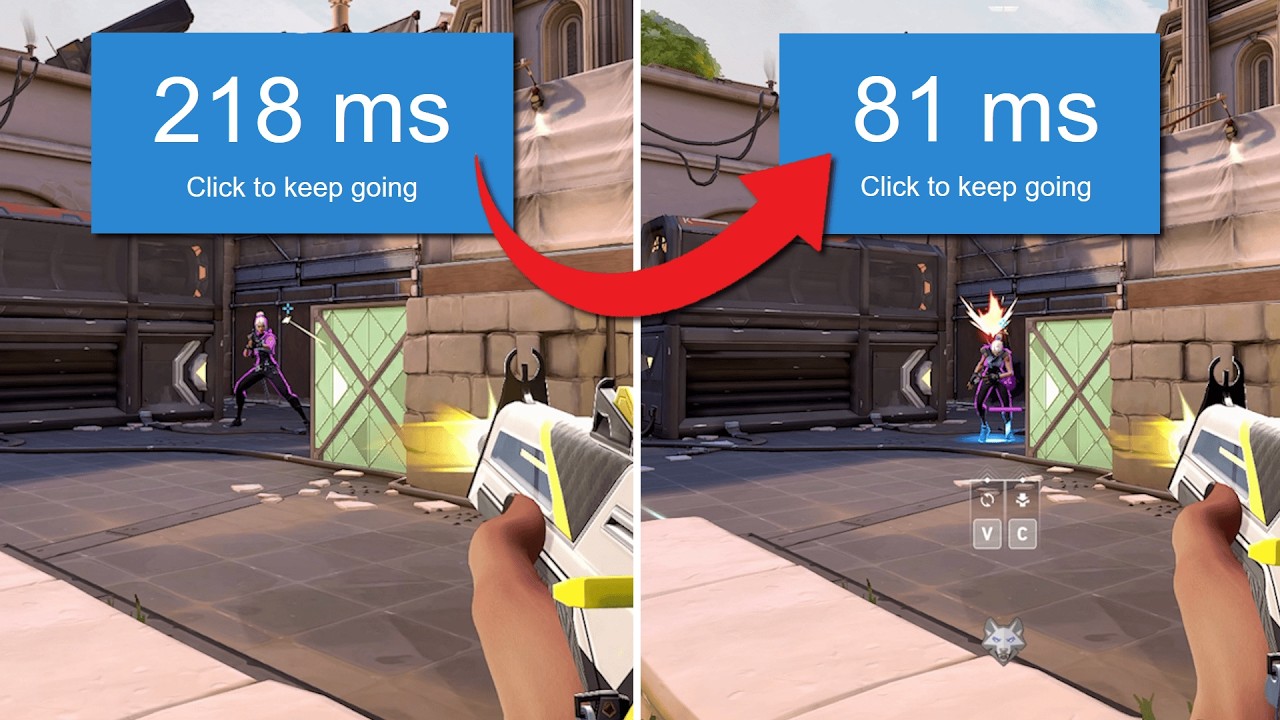
The Impossible Reaction Time
The average person’s reaction time is 200 milliseconds. Professional players can get it into the low 100s, but then, how are these players able to react even faster than that?
In this example hollow reacted in, on average, 58 milliseconds. This number isn’t just pushing up against the human limit of how fast you can be, this breaks right past it into the realm of the impossible. But… it isn’t impossible, these players can all do it and they’re not cheating. So that means they have to be doing something else to be able to react this fast… are they just guessing what the other person will do?
Prediction vs Reaction
Prediction: Guessing
Prediction is fairly common when trying to track someone moving like this, it can create crazy looking instances of perfect tracking but comes with the potential downside of… this (show missed prediction). What prediction is, at it’s core, is, like I said, just guessing and when you’re tossing a coin for every change in direction you’ll never be as consistent as the players I showed before. I don’t think prediction is always bad, but I don’t think it’s all of what they’re doing to aim like that.
Pure Reaction: Limited by Biology
The opposite of predicting movements is just… reacting to them, it’s probably the simplest approach and is generally fine but like I said before, we are limited by our reaction time here. For each time the target changes directions we have to see them start moving in the opposite direction, process that change in direction and then move our mouse accordingly, which creates a delay between every movement.
This is… completely normal and is also visible when watching a lot of very good players, but some people just don’t seem to have this issue? They look faster than what should be possible when aiming purely reactively.
The Third Dimension: Movement Reading
Well, that’s because there is a whole third dimension that is missing from this prediction to reaction spectrum, a trick that’s applicable to all of the games I’ve showed so far and that basically every top player is using, to some extent, even if they had never thought about it consciously. You don’t need crazy low reaction times if you know what the enemy is doing before they even do it and the best way to know that is through something called movement reading. The core of it is that you can pick up on cues present in the game to inform both your reactions and predictions. In my opinion, it’s almost essential to master when developing good aim, but, like I said, is almost never acknowledged consciously. Because of that, I think the best way to explain this concept is by using a genre where it’s a core feature of any players skillset: Soulslikes.
Learning from Soulslikes
In these games how you need to react to an enemies attack depends on the specific attack they do. So, they might go for a low sweeping attack that requires you to jump over it , or a thrust attack that you need to dash into to counter. Doing the wrong response for a certain attack can potentially just kill you outright and you can only know which response you need by focusing on the enemy and interpreting the information contained within their animations.
Animation Reading in FPS Games
Now, with this in mind, have a look at this animation. Before the target has actually physically started to change directions their playermodel has already begun to shift, presenting us with a lot of visual cues to pick up on to inform how we should react. This is the main component of how those players in the intro are able to adjust for movement as fast as they can, the animations telegraph what the enemy player is about to do. Like in this example from florescent, shes able to recognise the first few frames of the dash animation and account for that extra distance when she starts her flickshot.
Valorant: Subtle Animation Cues
That, and most other obvious examples, are extreme though. Usually the impact animation reading has in valorant manifests in much more subtle ways, hard to spot but still incredibly impactful. Like, how does sarah know that the clove in this clip will start strafing back? She doesn’t even try to correct to their new position, just lets them walk right into her crosshair. If they kept swinging she’d have been dead, but sarah isn’t guessing here. If you watch clove’s movement in slow motion it becomes more obvious how. There’s a snap visible here when the other player hits the key to change directions, which happens a full 150 milliseconds before they actually start accelerating. 150 milliseconds is a lot, it’s about my entire reaction time and sarah being able to pick up on the animation cue instantly and benefit from all of that time saved makes this clip look absolutely crazy to watch in real time.
Apex: Where Animation Reading Matters Most
And yet, even with how impactful animation reading clearly is, I think valorant is the game where this skill matters… the least! While it is an important factor within 1v1 fights, winning those fights can only take you so far. In something like apex where individual duels are more important and you need to keep your crosshair on the target instead of just clicking on them, the time taken to visually react to a change in direction is time your not doing damage in fights that can end the entire game for you if you mess up. Minimising time off the target is essential here, and all the information we need to do that is once again contained within those animations. Look at how vantage’s whole model shifts to the side before she strafes, or how this octanes shoulders slightly dip right before he’s about to change directions. Just like in valorant, the small details of animations give away how someone is going to move before they actually do.
Prediction in Tracking Games
But while there are a lot of similarities between how movement reading should be implemented in tactical fps games and tracking focused titles, there is one pretty massive difference and it comes back around to prediction. More specifically though, the potential downsides for predicting wrong. In valorant, while it might make sense to guess that your opponent will strafe a certain way and place your crosshair accordingly, I don’t know why you’d ever shoot based on that prediction alone. Like, this for example, just looks absurd. In a game like apex though, there are times where shooting according to prediction isn’t just a good play but is the best one for a certain situation.
Safe Predictions
For example here, as the octane goes behind the door hollow starts getting ready to track an immediate strafe back out and keeps firing in anticipation for the movement that doesn’t end up happening until slightly later. Hollow made an incorrect prediction here, but since the two outcomes were either the octane going behind the wall or the octane strafing back out there was no way he could be punished for that prediction. So, there isn’t any negative here, but the benefits for getting this prediction right are massive, we actually see that just before, the reason why hollow was able to track this octane so accurately in the first place was the predictions he made that were entirely safe based on the locations of the doors.
Informed Predictions
Another example is this one here, hollow knows that there’s a ledge blocking the enemy from continuing to go left, so he predicts that they will start moving back to the right and gets a perfect track on them because of it. I call situations like this informed predictions, the other person is basically never going to just keep running into a wall, exceptions withstanding, and because of that its safe to predict that they will change directions when they get too close to it. So while this is technically a guess, it’s an educated guess instead of a random one.
Acceleration Reading in Aimtrainers
But what if there’s no information to go off of? What if you can’t make out someone’s animations and have no environmental elements to predict with? What if the targets were perfectly spherical inside of a giant featureless box? Even in the isolation of aimtrainers which feature no animations at all, reading is still incredibly important, it just takes a bit of a different form. And with that new form, they open up a great way to actually train this skill
Reading Acceleration Curves
The core component of all the games I’ve talked about so far that makes animation reading as powerful as it is, is acceleration. Because someone takes time to accelerate to their maximum speed their animation change can give away what they’re doing before we can actually see them moving. But that gradual acceleration itself can also be read in a similar way. If you’re able to pick up on the way a target’s speed is changing over time you can infer what it will do going forward. Have a look at these couple of frames. It’s a shockingly small amount of information but from this alone we can tell that the target is starting slow and getting faster, and if you know how fast it can get you can follow this acceleration curve to that point.
This also lets you know when a target is going to change directions, if it starts to get slower it’s safe to assume you can follow that acceleration gradient all the way down then all the way back up for a perfect track. This is very hard to implement well though, both picking up on the change in speed initially and being able to aim well enough to match it once you do. That difficulty is what makes it so valuable though. Properly focusing on your target and picking up on slight changes in what they are doing is what’s so challenging about animation reading, so trying to do that but with more subtle tells like acceleration will make animation reading feel soo much easier. Which I think is the main reason this skill is worth training, even if animation reading is more useful overall.
How to Improve Movement Reading
So, if that’s one way to improve at movement reading, are there any other methods? Like I said, the biggest element is focus. Being aware of the skill in the first place is nice, but you won’t be able to actually utilize it if you aren’t, well, looking the enemy. Which also means that any method of making the enemy easier to follow visually is very important.
Smooth Mouse Movements
Try and focus on the circle on the left, versus the one on the right. Even though the circle on the right was covering larger distances it did so at a more consistent speed, making it easier to follow. This is something we can replicate in games by moving our mouse in less erratic motions. Even though it might seem intuitive to adjust back to the target as quick as we possibly can the moment we realise we are missing, that sharp movement makes it way harder for our eyes to track the target since they are now moving faster relative to our crosshair. If they change directions while that adjustment is happening we’d have no way to know until after the adjustment ends. On the other hand, if we have a much smoother approach we can read their movement right as it occurs, and can correct our adjustment in real time.
Playtime and Familiarity
That’s all the easy fixes I have though, the most effective and also hardest way to improve at reading movement is just… playtime. Familiarity with a games animations plays a massive role and is why pros can implement this technique so well without ever thinking about it, how their game works is like second nature to them. You can speed up the process of learning this though, by watching back some gameplay, taking note of what certain animations mean and trying to pick up on them actively in game, you can build that intuition way faster than it would develop otherwise. In a lot of games the area to focus on will be their legs and that’s generally what I try to focus on when trying to read movement in an unfamiliar game, but this does vary and I think it’s worth trying to consciously isolate which area of their playermodel would be the best to internalise.
Aimtrainer Practice
There are also some scenarios in aimtrainers like the ones shown on screen that are very heavily focused on acceleration reading. They all have targets with very gradual acceleration that you have to match as it slows down and speeds up to get a good score, and I found them really useful for improving my ability to fully focus on a single target. To isolate this skill further I personally liked playing easier versions of the scenarios than usual, so instead of struggling to hit the bot at all I could fully focus on matching its speed and acceleration.
Training Prediction
Unfortunately there isn’t any similar training method for predicting movements. Knowing when and when not to implement prediction into your aim based on the environment is something that develops from lots of playtime. I’d say if you’re newer it’s better to not predict at all than to predict too much, since it will lose you a lot more gunfights than it will win you if you aren’t implementing it mindfully. Vod reviews might help speed up the process though, letting you analyse when you should or shouldn’t predict based on the situation without the stress of actually being in the game.
Final Thoughts: Reaction Time Isn’t Everything
I know it might be feel a bit strange to end a video about how to react faster without learning how to improve your actual visual reaction time, but truth be told I don’t think it holds basically any significance. If it’s something your worried about or it’s exceptionally slow it might be worth training, and I personally have gone from over 200 to almost 140 now after a few years through aimtraining and improving my health, but I certainly didn’t feel slow in games before. This one number has been something I’ve seen blamed over and over for poor in game performance but truthfully is such a tiny fraction of what makes up a good player. It really isn’t worth worrying about and I think being able to read movements well is a far better and more practical thing to spend that energy focusing on.