The problem
Mouse grip is a bit of a tricky topic to discuss. It’s something I’ve seen so many people overthink to their detriment and yet I entirely understand why they do it. Because mouse grip does dictate a lot about how someone aims but it also doesn’t really matter, it’s not worth overthinking. To explain this contradiction though I need to go over why people overthink it in the first place.
What defines a mouse grip?
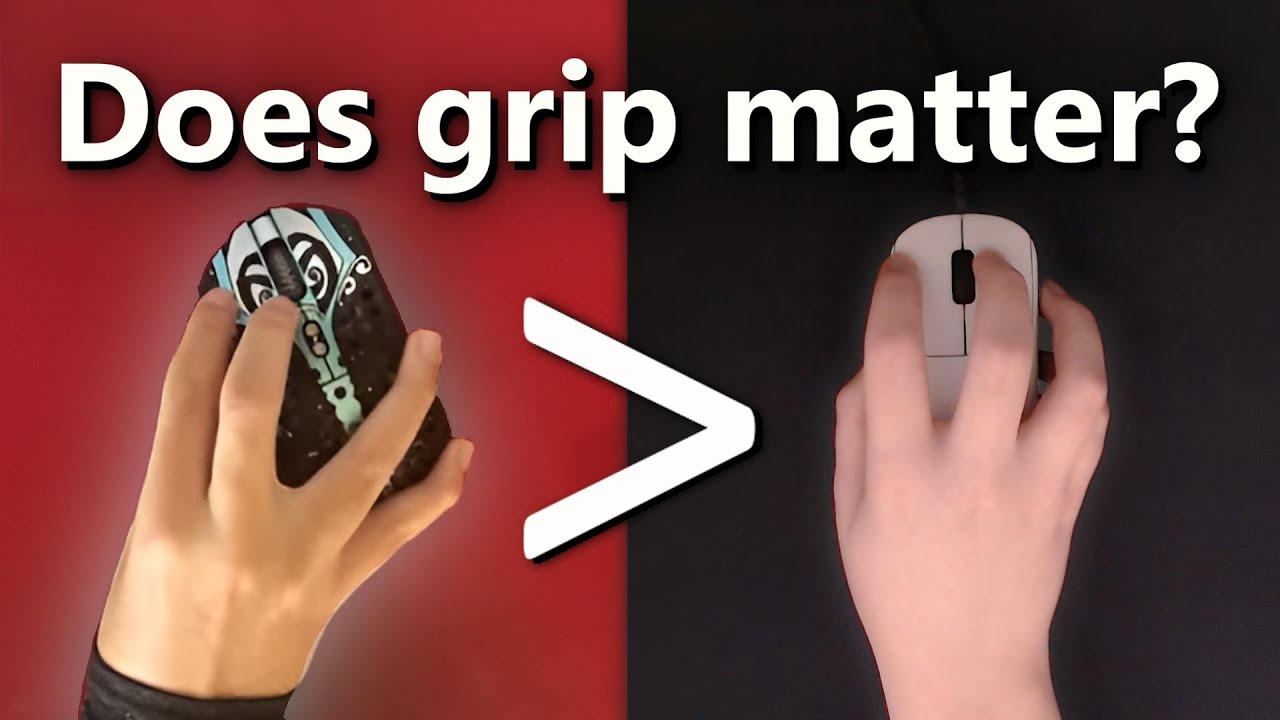
There are three main ways to hold a mouse, palm, claw and fingertip. These categories won’t cover every little detail of your grip style but the two main things that separate these three are the most relevant ones for how your grip impacts your aim: palm contact and finger mobility.
Palm Grip
A standard palm grip has you fully press your palm against the mouse, with the index and middle fingers laying flat along the top.
This is actually how I used to grip—back then I played a lot of Counter-Strike and having the mouse totally locked in place helps with stability which is extremely important for winning duels in that game.
When I started to pick up other games though I ended up raising my sensitivity and on that higher sens, I noticed that I was struggling to make smaller corrections when aiming. While the stability offered by palm grip was nice, it came with a tradeoff:
When aiming with palm grip you lose the ability to move the mouse with your fingers and limit yourself to just wrist and arm.
And that wasn’t too big of a deal in counter strike, I played with a really slow sensitivity and my arm and wrist were precise enough. But as I raised my sens and played games that required more vertical movement specifically, I felt that this grip was holding me back.
That’s when I did some looking around online and found people using fingertip grip.
Fingertip Grip
Coming from palm this looked so unnatural, but the thought process behind it made sense. The idea was that by creating that clearance between the palm and the mouse there was enough room to move the mouse vertically exclusively with your fingertips. This gave a level of fine control vertically that just wasn’t possible with palm grip, and since being able to use your fingertips could help make and stabilise horizontal movements as well, it seemed like the obvious choice.
With my new higher sensitivity I needed that precision for small movements and I decided to make the swap. Personally though, no matter how much time and practice I put into this grip style, I couldn’t get over it’s downsides.
When making wider flicks with my arm I felt that I had to apply a lot of pressure to the mouse to keep it firmly in place. To achieve this I put more tension in my fingers, tension that I couldn’t release quickly after a flick which made my microadjustments shakier.
It created a disconnect between small and large movements and I found myself just using my wrist instead.
So, if both extremes have tradeoffs, why not try to strike a balance?
Claw grip
Claw grip is characterised by having the base of the palm touching while the fingers on top of the mouse curl.
This lets it provide some vertical finger mobility while still having a bit of the stability benefits that palm grip offers and it mostly avoids the tradeoffs of the other two grips, but it cant provide their full benefits either.
This is what I ended up choosing, it works well for me for the most part, more on that later, but for some people, striking that middle ground just isn’t good enough. They might play on a higher sensitivity and claw grip just doesn’t offer the fine control they need to remain precise on that sens, and on a sens that high, you don’t need to make those large, cross mousepad movements anyways, so why not use fingertip? And even though I wouldn’t recommend it most of the time palm grip can still work; if your sensitivity is low enough you probably don’t need fingertip mobility but those stability benefits could win you gunfights.
The Perfect Mouse Grip… doesn’t exist.
This also explains how the concept of the perfect mouse grip is fundamentally flawed, since each grip has different benefits and weaknesses which is best depends not only on the main game someone plays but also their sensitivity and handsize. There is no universal best grip.
But if all of this is true, how can mouse grip not matter? I spent so much time experimenting to find what worked best after swapping games, and eventually I did settle on claw, right? For the most part yes, and there is nothing wrong with experimenting especially since none of these grips are objectively the best for aiming, but it’s not worth overthinking because of two key concepts: comfort and adaptability, which sounds confusing but by adaptability I just mean that your grip will naturally change based on what you are doing.
Mouse grip is descriptive, not prescriptive.
This is why I don’t say that I’ve fully settled on a gripstyle, if you watch my hand as I play you’ll see a lot of details about how I hold the mouse change based on the situation. An example of this is that when I flick, I’ll put more downwards pressure on the mouse to increase my stopping power but there are more extreme changes as well like swapping to fingertip grip when I know I’m going to make use of that vertical freedom of movement. This is entirely subconscious and from what I’ve seen is fairly common, most people I’ve asked do the same and this is reflected in a poll I put up on twitter.
But then, why didn’t I naturally swap from palm grip in the past? I had to consciously think about different options and choose to try them. That’s because I left out a very important detail earlier: at the time I was using the Logitech g502, a very heavy mouse designed for palm grip. The weight prevented me from comfortably moving it with my fingers and it was way too big for me to claw. I got a new mouse when I tried to swap to fingertip grip and it’s what made that switch possible for me but, going from fingertip to claw after that was entirely subconscious, I didn’t think about it at all and just naturally found what worked best for me by not forcing myself or having a mouse force me into a certain style.
This leads nicely into what I think is the most important element of how you hold your mouse, comfort.
You won’t feel the benefits of any of these grip styles if they aren’t comfortable for you or compatible with your current mouse and, while it might be tempting to try and force a grip style to match how someone else holds the mouse or because you think it’ll help your aim, if it’s causing you pain or just isn’t comfortable, it’s not worth doing.
Most of the time, the grip you naturally gravitate towards when putting your hand on the mouse is what’s going to work best for you—it’s how I ended up with my current grip style.
Should you ever change your grip?
But what if how you hold the mouse naturally is causing you pain? Then it makes sense to try other options in terms of grip, but you might find that your mouse just doesn’t work for your hand. As obvious as it sounds, I didn’t realise for a long time that holding a mouse isn’t meant to be painful and if no grip style feels comfortable it might be worth looking getting a mouse that better suits your handsize.
This is 1 of 2 situations where I think it makes sense to think about your grip consciously, if your hand hurts or it doesn’t feel comfortable, try different grips and see if that helps.
The other situation is a lot more mechanical:
If you’re noticing when watching your vods back that your consistently struggling to make small vertical microadjustments and you use a palm or sometimes it can happen with claw grip, you might not be able to engage your fingers enough when aiming. Without being able to microadjust with your fingertips you have to use the next closest muscle, the shoulder, which is nowhere near as accurate.
In either of these situations I think experimenting with grip style is beneficial but I still wouldn’t overthink it. In my opinion, it’s never worth it to hyperfocus on the exact location of all your fingers or try to force the the exact same grip each time you play, gripstyle is a lot more malleable than people think and it’s totally normal for it to change from day to day or even throughout a play session.
It’s important to remember when discussing things like this that they should always be secondary to practicing and focusing on weaknesses. Most of the benefits of swapping grip style, especially for smaller changes, don’t come without a tradeoff. This is true for most of these so called “instant improvement methods” honestly, it’s very easy to fall into the trap of thinking that to get better you just need to find the secret mouse grip, or setting, or sensitivity and so on. While changing one of these might help in extreme cases, most of the time it won’t make a significant difference and at the end of the day, the biggest defining factor for how good you are is the time you put in, not your grip style.