Introduction
You’ve probably heard of mouse accel by now. While it’s always been a topic of discussion in more niche gaming circles, only pretty recently through countless youtube and tiktok videos has it become more mainstream, mostly due to the pretty bold claims they tend to make about it. But given all of this praise, why have so many people, myself included, tried accel before giving up on it? I think to properly talk about that we have to go back and look at exactly what mouse acceleration is and what makes it a supposed “cheat code” for aiming.
What is Mouse Acceleration?
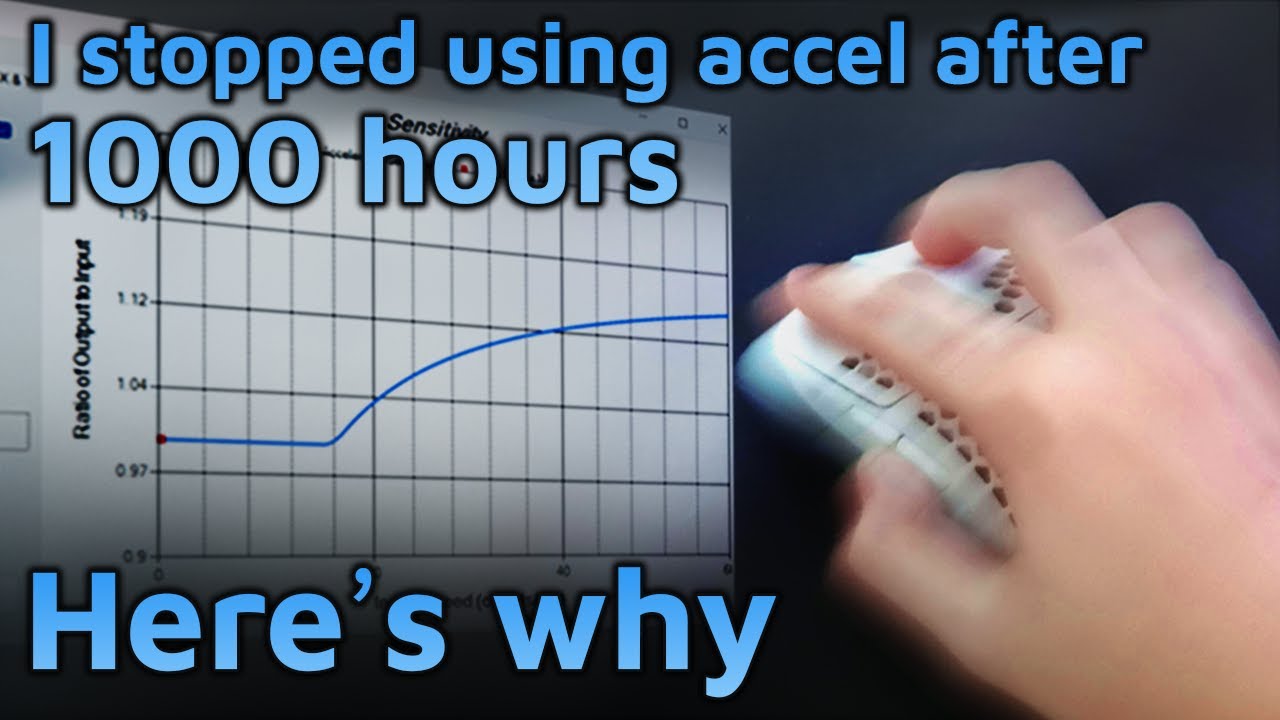
The basis of mouse accel is that the faster you move your mouse, the faster your sensitivity. More common forms of accel had set sensitivity curves, which were often pretty unintuitive, while modern software allows you to customise it to your preference.
The Pitch: Best of Both Worlds
Think of your sensitivity as a tool, with high and low offering different benefits for different situations. The common pitch for mouse accel is that it allows you to get the best of both. When your moving your mouse fast, say, flicking for example, you’d want a faster sensitivity for a boost in speed, but when your moving slowly, typically when tracking or microadjusting, you want to be using a slower sensitivity for extra stability and control. And when I first tried mouse accel, I honestly felt all these benefits. My flicks were fast and snappy, and my tracking was far more controlled than before. The best way to describe it was intuitive, it just felt right.
Initial Benefits
Before I used accel I had this issue where at the end of a flick, there would be a bit of shaking as I tried to stop the mouse moving. On accel this entirely vanished because as you slow down your sensitivity does too, meaning that any unwanted small movements are minimized, helping your stopping power.
My Year with Mouse Accel
I stuck with accel for about a year, and put a few hundred hours of playtime onto it. Over this time I had become a way better player in csgo and battlefield, my main 2 games, and at this point, accel was just my default. I didn’t really think about it, didn’t touch my settings, it was just what I used. Throughout this time period I picked up some other games but when I tried apex and overwatch I was terrible, I just couldn’t hit a shot and didn’t know why.
Hitting a Brick Wall
During my time on accel I also got more into aim training, after a playing the voltaic benchmarks for a while I had got some relatively good scores but I began to notice something. While I was consistently improving in speed focused scenarios I felt stuck on things like tracking and static clicking despite putting a lot of time into both. On 1wall 6targets small, I didn’t get a single personal best for almost an entire year. I decided to watch some top players videos of the scenario to see how they approached it, and when going through bardoz’s channel, the world record holder at the time, I noticed that just a few months prior he was at a similar skill level to me, so what was he doing differently? I tried changing my technique, slowing down my flicks and focusing on accuracy like he did, I tried high and low sens and I even swapped mice, but nothing helped. I felt like I’d hit a brick wall.
The Breakthrough: Advice from Bardoz
About a month after this I ended up actually working with bardoz on an unrelated project, and I asked him afterwards if he could give me some advice for static clicking. After watching my video he instantly pointed out my microadjustments, I didn’t have the stability that you need for high level static scores. This made a lot of sense, these kinds of movements are similar to the ones seen in tracking and my instability could be holding me back in both areas. But why wasn’t I getting any better at them despite all my practice?
When I mentioned that I used accel, bard said that he had actually experienced a similar issue when he had tried mouse accel, a lack of confidence in his microadjustments. He strongly suggested that I turned accel off, but I wasn’t sure. It was something I honestly hadn’t considered, like I said it was my default and I’d gotten so much better as a player over my time using it. Was it really possible that after all this practice, it was holding me back?
Turning Off Accel
Despite my skepticism, I was getting pretty desperate this point so I decided to try, just for a few days, to see if turning it off helped. After so long on accel, it had become so natural that it felt very strange to play on a static sensitivity again. Initially, every sens I tried felt really sluggish, I had to go almost twice as fast as what I was playing on before to get something that felt comfortable, and while my flicks were definitely worse, after I got over this initial adjustment period I began to notice improvement again. My scores began to equalize between the categories and 3 days after turning off mouse accel, I finally pb’d in 1 wall 6 targets small.
Why Mouse Accel Was Holding Me Back
So, bardoz was right, it was mouse accel that was limiting me. But why? With the amount of time I had on accel, I was about as close as you could get to fully “learning” an accel curve, this shouldn’t have happened.
The Double-Edged Sword
Remember that quirk I mentioned earlier? How accel helped my stopping power? That goes both ways. While the accel is working with you when you are trying to stop a movement, it works against you when trying to start them if you’re not moving your mouse particularly fast. The slowdown creates this extra resistance against your movements, forcing you to fight against it when making any motion that isn’t a fast flick.
Muscle Group Mismatch
This is a part of the pitch of accel, this resistance is meant to offer extra stability. Personally though, I don’t agree with the notion that you want a faster sensitivity for flicks and a slower one for tracking. For flicks I like to use my arm primarily due to it being able to reach a higher maximum speed than my wrist can. My wrist on the other hand can accelerate quicker and has more fine control, making it well suited to smaller distance movements, like adjusting to an enemy after a flick or preaiming for example. This goes against what accel strives for, which is fast sensitivity for flicks forcing you to use your wrist and slower for smaller movements, which forced me to use my arm for them.
The Training Problem
When training microadjustments, you have to first get consistent at making the movement slowly before you can speed it up to make sure you’re accuracy is solid at those high speeds. Accel prevents you from practicing like this. I would train my micros, starting slow and building some consistency at that speed, but when I tried to go faster, I would overshoot everything because of the sensitivity increase. This meant I could never really get comfortable with my small adjustments with accel on the way I could with flicks. This is why I struggled in overwatch, the fast strafe speed forced those quick adjustments.
Accel as a Band-Aid
All this culminates in accel acting as a band-aid for poor mechanics. It covers up instability in microadjustments with it’s slowdown, and can be used to make up for a lack of raw speed when flicking. For newer players, it probably will provide some quick improvement due to it covering these underlying issues, which I think is why it’s spoken of so highly. Personally though, I found that as I got better as a player, accel served to limit my improvement instead of helping me. I think it’s better to tackle these issues head on with training and isolated practice, rather than seeking quick fix solutions, like mouse accel.
Two Years Later
Now it’s been about 2 years since I initially turned off accel, and I have become a far better player for it. I have improved significantly on static, and tracking, which was before my weakest skill, is now my strongest. I have tried to go back to accel a few times since initially turning it off, but in retrospect it is painfully obvious how limiting it can be.
What I Don’t Regret About Mouse Accel
But with all of that being said, I don’t regret using mouse accel. While it might sound a bit strange considering I’ve spent the past 5 minutes talking about how it hindered me, accel helped me in a lot of ways too even though it didn’t live up to it’s reputation.
Benefit 1: Sensitivity Adaptability
When I first swapped to accel, I had spent my whole life playing on extremely low sensitivity. I had tried to raise it before but really struggled to adapt. Accel not only helped me adjust to high sens pretty much effortlessly, but also made it far easier to adjust to a change in sensitivity generally. Now, I can switch between anywhere from 20 to 60cm/360 and still perform well, I think partially due to accel forcing me to effectively use multiple sensitivites at once. Without trying accel, I think there’s a chance that I’d still be playing everything on stupidly low sens.
Benefit 2: Motivation and Mindset
That was only the second most important thing that accel did for me though. The reason why I initially started using accel at the start of 2020 was because I was demotivated, I didn’t really feel like I had anything to train for. As silly as it sounds, trying a setting as strange and unconventional as mouse accel gave me the motivation I needed to properly start practicing and consciously working on my mechanics. It, in a way, kickstarted the mentality I have today towards getting better at things, and when first trying it out, seeing that instant improvement was pretty motivating, even if it was only covering weaknesses, not fixing them.
Final Thoughts: Should You Try Accel?
I don’t want people to be scared to try accel due to my experience. Like I said, I don’t regret using it, but I think it’s important to try things like accel for the right reasons; there is no way to get better instantly. Skill comes from countless hours of dedicated practice, and any attempts to get around that will just come back to bite you in the long run. If you are trying accel with the idea that you will instantly become a good aimer, you will be disappointed. But if you are looking to try a more unconventional way of aiming and the concept sounds appealing to you, it might be worth a try, especially if you think it might motivate you to more actively work on your aim like it did for me.